

Showing posts with label exoplanet detection. Show all posts
Showing posts with label exoplanet detection. Show all posts
Tuesday, July 10, 2012
What is Project 1640?
Detecting Extrasolar planets is tough work. Most of the detections gave been indirect (only 5% of exoplanets have been observed directly). Now, a new promising method of exoplanet detection is debuting and it is called Project 1640. However, before we describe what Project 1640 is all about, let's review all the current methods that we can use to detect an extrasolar planet outside of our Solar System:
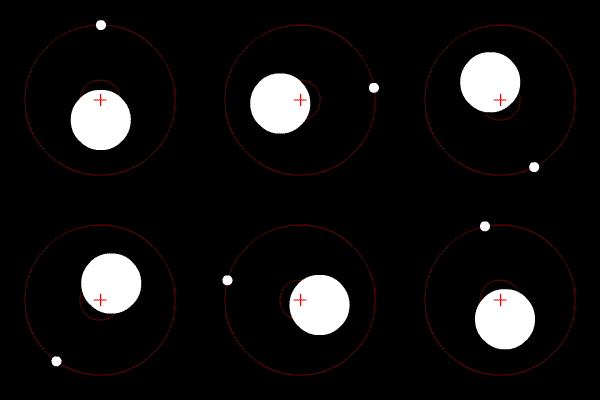 1) Radial Velocity Method: AKA Doppler Spectroscopy. This method basically watches for a star to wobble. What does a star wobble mean? It means that the star is being gravitationally affected by its own orbiting planets. Both planet and star both tug on each other through gravity. Have you ever spun in a circle with a friend, hands locked together? Did you notice that you kind of have to lean back in order for both of you to spin smoothly. What this does is it creates a kind of "center" between the both of you. Suns and their planets do the same thing. As they spin together, the sun will oscillate back and forth - wobble in place - in accordance with the strength and speed of the planet that is orbiting. This method excels at detecting planets larger then Jupiter, generally. This is because larger planets cause their parent stars to wobble considerably more than smaller planets, thus making the star's wobble easier to detect. This wobble effect is detectable because of the Doppler Effect. The frequency of light waves change as the object emitting them is in motion. And this change in frequency is detectable.

Subscribe to:
Posts (Atom)